
Rounding Bottom: Saucer Reversal Pattern
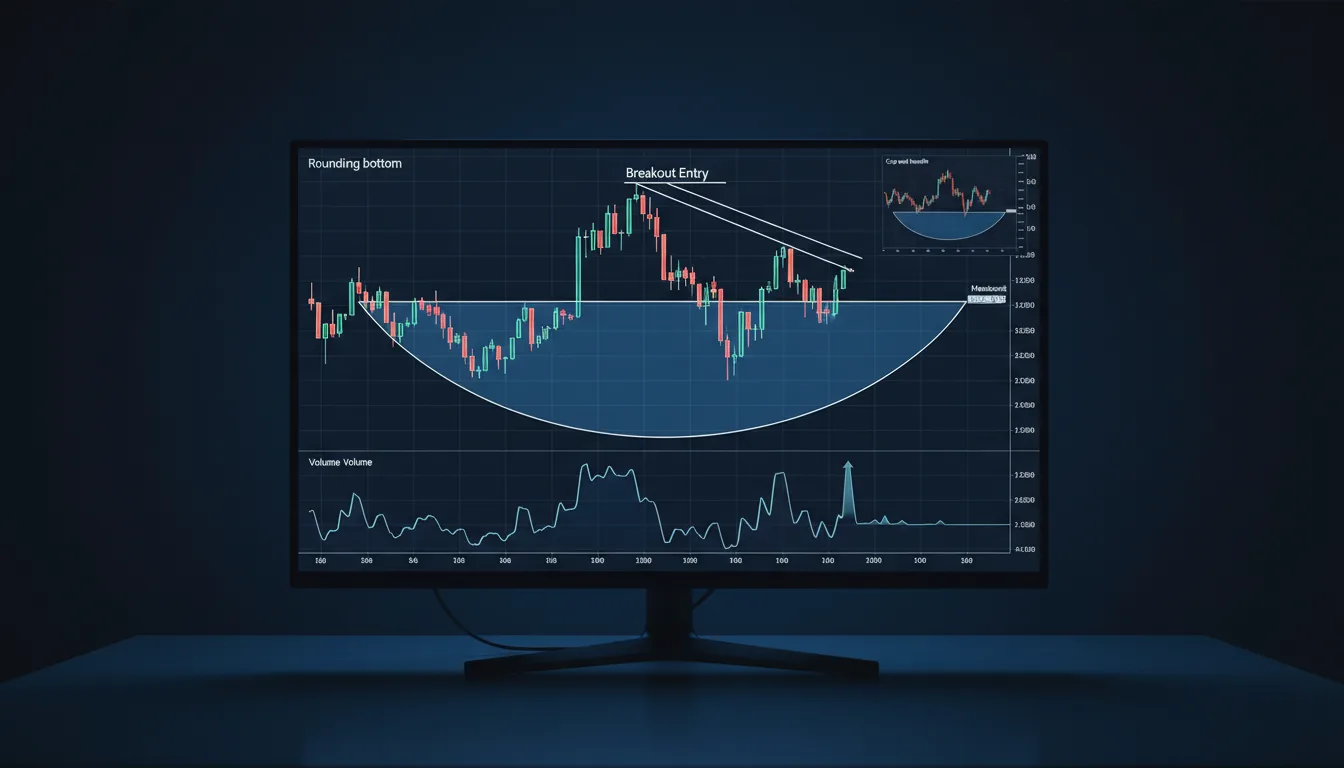
A rounding bottom, also called a saucer or bowl, is a slow bullish reversal pattern shaped like a gradual U. Price drifts lower, flattens out at a low, and gradually curves back up, often over weeks or months. It signals a quiet, steady shift from a downtrend to an uptrend.
Key takeaway
What is a rounding bottom pattern?
A rounding bottom is a reversal pattern that forms after a downtrend, tracing a smooth, U-shaped curve as price gradually bottoms and turns higher. Unlike sharp reversals, it develops slowly, reflecting a quiet, incremental change in the balance between sellers and buyers.
The pattern sits in the family of reversal setups described in our guide to chart patterns. Its defining trait is gradualism: there is no single dramatic low or sharp V, just a steady rounding. Reading it well builds on a grasp of support and resistance, since the breakout level is the resistance left behind on the saucer's upper-left edge.
What does a rounding bottom look like?
A rounding bottom looks like a shallow bowl or saucer. Price declines at a slowing pace, flattens through a quiet basing area, and then curves upward at an increasing pace, eventually reaching the resistance set at the left side of the pattern.
- Left side. Price declines and the downtrend gradually loses momentum, with the slope flattening.
- Base. A quiet, rounded low where selling pressure fades and the pattern's curvature is most visible.
- Right side. Price recovers in a mirror of the left, eventually approaching the old left-rim resistance, where a breakout completes the reversal.
How do you trade a rounding bottom?
Because the pattern develops slowly, most traders wait for price to break above the resistance at the left rim of the saucer before treating the reversal as confirmed. Acting earlier, while price is still rounding, risks committing to a base that has not yet proven itself.
A common approach is to enter on a confirmed close above the rim, ideally on rising volume, with a stop placed below the recent basing area. Some traders also watch for a pullback to retest the broken rim from above. Patience is the theme: a rounding bottom rewards waiting for the breakout rather than trying to call the exact low in real time.
Why does volume matter in this pattern?
Volume often mirrors the saucer shape and is one of the most useful confirmations. In a textbook rounding bottom, volume is heavier on the left as the downtrend exhausts, fades to a low through the quiet base, and then builds again as price curves up and approaches the breakout.
This U-shaped volume signature reinforces the price story: selling pressure drying up at the bottom, then buyers gradually returning. A breakout above the rim accompanied by clearly rising volume lends the most credibility, while a breakout on thin volume is more prone to fail. Volume is not strictly required, but the matching volume curve is a strong supporting signal for the reversal.
How long does a rounding bottom take to form?
A rounding bottom is one of the slower patterns to develop, often unfolding over many weeks or months on a daily chart, and sometimes longer on weekly charts. The gradual curvature is the whole point: it reflects a slow, grinding handover from sellers to buyers rather than a sudden change of heart.
This long time horizon is both the pattern's strength and its weakness. On the plus side, a base that took months to build can support a durable move once it breaks, because the accumulation is broad and deliberate. On the downside, the pattern is hard to recognize in real time, since the curve only becomes obvious in hindsight, and a developing rounding bottom can stall or roll back over before it ever reaches the rim. This is why patience and breakout confirmation matter more here than with faster, sharper patterns, and why the rounding bottom suits position-oriented traders more than those looking for quick setups.
Rounding bottom vs cup and handle
A rounding bottom is closely related to the cup and handle. In fact, the cup in a cup and handle is essentially a rounding bottom, with one addition: a short pullback called the handle that forms just before the breakout.
The plain rounding bottom has no handle and tends to be a slower, longer reversal that follows a downtrend, while the cup and handle is often a continuation pattern within an uptrend that includes the distinct handle shakeout. It also resembles the double bottom, but a double bottom traces two sharp lows (a W) rather than a single smooth curve. Identifying the exact shape matters, because the entry and the role of the handle differ.
Putting the rounding bottom in context
The rounding bottom is a disciplined way to spot a slow, quiet reversal that many faster patterns miss. Its value comes from a checklist: a smooth saucer shape, a U-shaped volume signature, a confirmed break above the left-rim resistance, and a measured target treated as a guide.
If you are still learning to spot reversals, study the cup and handle and the double bottom, and ground yourself in chart patterns first. Bullynx can also read a chart screenshot and point out where a potential rounding bottom sits relative to the rim and the prevailing trend.
Frequently asked questions
- What is a rounding bottom pattern?
- A rounding bottom, also called a saucer or bowl, is a slow bullish reversal pattern shaped like a gradual U. Price drifts down, flattens at a low, and gradually curves back up, often over weeks or months, signaling a quiet shift from a downtrend to an uptrend.
- Is a rounding bottom bullish or bearish?
- A rounding bottom is bullish. It forms after a decline and marks a gradual transfer of control from sellers to buyers. The mirror image at a top, a rounding top or saucer top, is bearish.
- How do you trade a rounding bottom?
- Many traders wait for price to break above the resistance at the left rim of the saucer, ideally on rising volume, before treating the reversal as confirmed. A stop can be placed below the recent base, and the target is projected from the depth of the saucer.
- What is the difference between a rounding bottom and a cup and handle?
- A cup and handle is essentially a rounding bottom (the cup) with an added short pullback called the handle before the breakout. A plain rounding bottom has no handle and is often a slower, longer reversal that follows a downtrend.
- How reliable is the rounding bottom pattern?
- It is a recognized reversal pattern, but it develops slowly and can be hard to confirm in real time. A smooth saucer shape, a volume signature that dips at the low and rises into the breakout, and a confirmed break of the rim make for a stronger read.
Seeing this setup on your own chart? Upload the screenshot and Lynx AI maps the structure, the levels that matter, and a long or short bias, with what would invalidate it.
Keep reading
- Double Bottom Pattern: Bullish ReversalChart Reading & Patterns
- Cup and Handle Pattern: How to Trade ItChart Reading & Patterns
- Double Top Pattern: Bearish Reversal GuideChart Reading & Patterns
- Flag Pattern: Bull & Bear ContinuationChart Reading & Patterns
- Gap Trading: How to Trade Price GapsChart Reading & Patterns
- Head and Shoulders Pattern: How to Read ItChart Reading & Patterns
Educational only. Not financial advice. NFA. Bullynx is not a registered investment adviser or broker-dealer. Trading and investing involve significant risk of loss. Read the full risk disclosure.