
Supply and Demand Zones: How to Draw Them
Last updated September 4, 2026
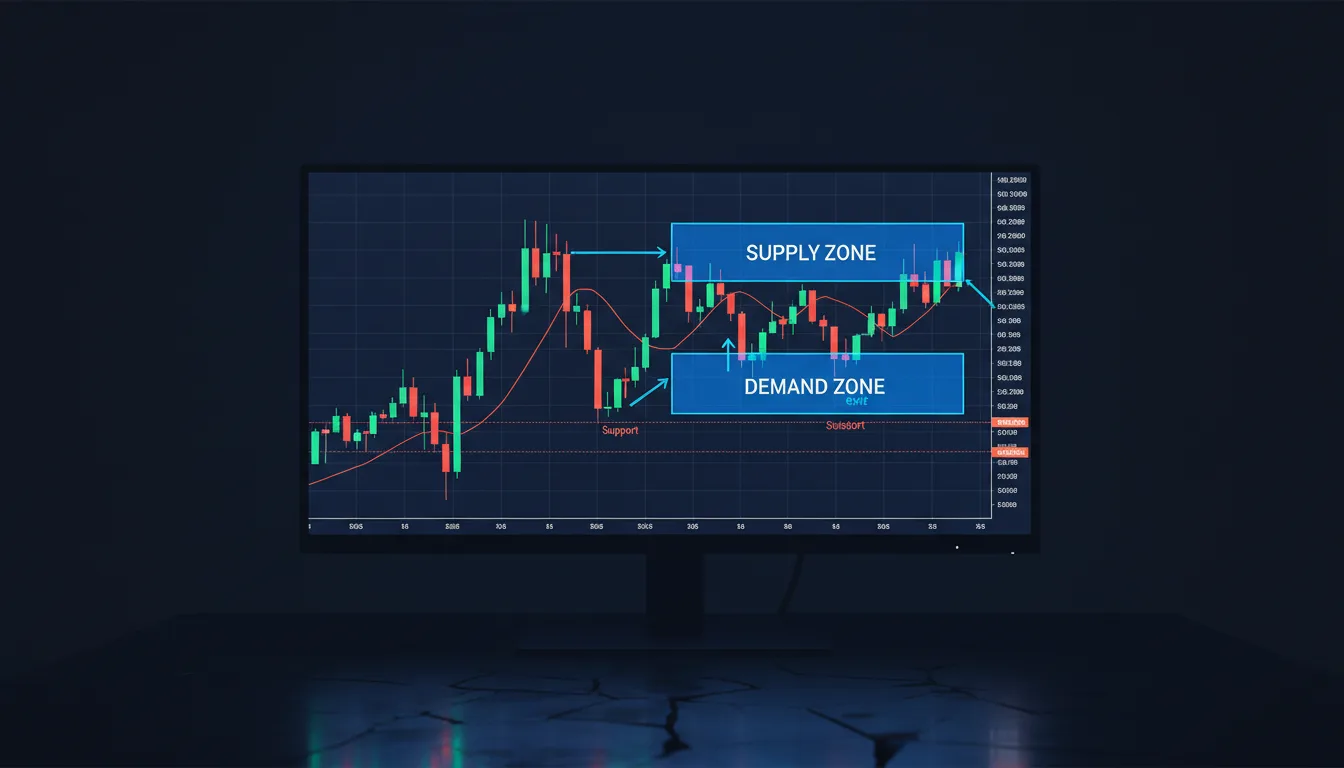
A demand zone is the price area where buyers overwhelmed sellers and price left quickly to the upside. A supply zone is the mirror, the area a sharp decline began from. Both are drawn as bands rather than lines, because the orders that caused the move sat across a range of prices.
Key takeaway
A demand zone is the origin of a strong up-move (buyers dominated); a supply zone is the origin of a strong down-move (sellers dominated). Draw them as the base, the tight consolidation just before the impulsive move, and treat them as areas, not lines, since orders cluster across a range. When price returns to a zone, traders watch for a reaction and trade in the direction of the original move.
What are supply and demand zones?
Supply and demand zones mark the price areas where one side of the market decisively overwhelmed the other, producing a sharp, impulsive move. A demand zone is where aggressive buying absorbed all the selling and launched price upward; a supply zone is where aggressive selling absorbed the buying and drove price down. The logic is that not all the orders at that origin were filled, so unfilled interest may remain, ready to react if price returns.
This reframes support and resistance through the lens of where strong imbalance occurred rather than simply where price bounced before. The defining feature of a good zone is the strength of the move that left it: a sharp, fast departure signals a strong imbalance and a more significant zone, while a sluggish drift suggests weak interest. Supply and demand thinking is closely tied to smart money concepts and overlaps heavily with classic support and resistance, which it refines into areas of unfilled orders.
How do you draw a supply or demand zone?
Drawing a zone starts with finding the base, the tight consolidation or small cluster of candles right before a strong impulsive move away. That base is where orders accumulated before the move fired, so it marks the origin of the imbalance. You draw the zone from the edge of that base to the open of the first big impulsive candle, capturing the area price departed from rather than a single price.
The quality of a zone depends on a few features: a clear, tight base; a sharp, decisive move away (often called the "leg out"); and ideally a zone that has not yet been retested, since the first return to an untested zone is considered the strongest. The chart below illustrates a demand zone, a base, then a strong rally, with price later returning to it.
Marking zones cleanly takes practice; the discipline is to require a genuine base and a strong move, not to label every wiggle a zone.
Why zones, not lines?
The core reason to use zones rather than lines is that real orders cluster across a small price area, not at one exact tick. A single horizontal line implies a precision the market does not have, so price often reacts a little above or below it, leaving line-traders either stopped out early or missing the entry. A zone gives realistic room for that reaction, treating the origin of a move as a band where buying or selling interest may reside.
This also makes zones more forgiving and more honest about uncertainty. Price returning to "around" a zone is enough to watch for a reaction, whereas waiting for an exact line touch can mean missing the trade. The zone approach acknowledges that the level is approximate and that the signal is the reaction within the area, not a precise tag. This area-based thinking distinguishes supply and demand from the line-based habit many traders bring from basic support and resistance, and it connects to the broader idea of order blocks explained, which are a specific kind of zone.
How do you trade supply and demand zones?
The standard approach is to wait for price to return to a zone and look for a reaction before entering, rather than entering blindly on the first touch. When price re-enters a demand zone, traders watch for signs that buyers are stepping in again, a rejection wick, a reversal candle, a pause, then enter long in the direction of the original up-move. The mirror applies to supply zones for shorts. The reaction within the zone is the trigger, not the mere arrival.
The stop sits beyond the far edge of the zone, the price at which the zone has clearly failed, and the position is sized so that stop respects your risk. A useful refinement is to favor fresh, untested zones aligned with the higher-timeframe trend, since a zone that agrees with the dominant direction and has not been used up is more likely to hold. As with any single technique, zones work best with confluence, alignment with trend, structure, or other levels, rather than in isolation. Combining a zone reaction with a break of structure read, for example, strengthens the case.
Not every zone holds, and a zone can break on the retest. Require a reaction within the zone before entering, place the stop beyond the zone's far edge, and size so a failed zone is a small, planned loss, not a surprise.
Can an AI chart reader draw supply and demand zones?
The mechanical part goes well. From a screenshot an image-based reader can find the sharp departures, walk back to the base each one launched from, and box it, applying the same rule to every candidate rather than only to the one that suits a position. Because zone drawing is notoriously subjective, having a consistent second set of boxes is useful precisely where traders are least reliable.
Two limits matter. First, a zone's value depends on how much of it has already been eaten, and touches that happened before the left edge of the crop are invisible, so a zone the model presents as fresh may have been tested twice last week. Second, it cannot rank zones by higher-timeframe importance without seeing the higher timeframe, so it will offer you five zones of apparently equal weight when only one is worth waiting for. Supply the history and the context, let it handle the drawing, and treat the AI chart analysis output as a candidate list rather than a plan.
Putting supply and demand in context
Supply and demand zones offer a clean, order-flow-flavored way to read where price may react, grounded in the simple idea that strong moves originate from imbalances that may not be fully resolved. By focusing on the origin of sharp moves and treating those origins as areas rather than lines, the approach gives more realistic, tradable levels than a rigid single-price view, while staying rooted in the same support-and-resistance logic most traders already use.
The discipline that makes it work is selectivity and confirmation: mark only genuine bases with strong moves away, favor fresh zones aligned with trend, wait for a reaction on the retest, and always anchor entries to a stop beyond the zone. Used this way, supply and demand zones become a high-quality subset of support and resistance rather than a magic level. They sit comfortably within the price-action toolkit alongside market structure trading, the smart money version of the same base known as an order block, the imbalance an impulsive departure leaves behind, and the Wyckoff accumulation and distribution ranges the whole idea descends from. Plain definitions for each term live in the glossary.
A final point about zone lifespan: zones weaken with use. The first time price returns to a fresh zone, the most unfilled interest is likely still there, so the reaction tends to be strongest. Each subsequent test consumes more of those orders, so a zone tested several times is progressively more likely to break. This is the opposite of the intuition some traders bring from support and resistance, where repeated holds feel reassuring; with order-flow zones, a much-tested zone is closer to failing, not stronger. Favoring fresh, untested zones and treating heavily retested ones with caution keeps you trading the areas where the imbalance is most likely intact.
Educational only. Not financial advice. Supply and demand zones are descriptive areas, not guaranteed reversal points, and can fail. Examples use illustrative data. Always do your own research.
Frequently asked questions
- What are supply and demand zones?
- Supply and demand zones are price areas where buying or selling was strong enough to cause a sharp move. A demand zone is where buyers overwhelmed sellers and price rose; a supply zone is where sellers overwhelmed buyers and price fell. They are areas, not exact lines.
- How do you draw a supply or demand zone?
- Find the base, a tight consolidation, right before a strong move away, and mark the area from the base's edge to the start of the impulsive candle. The zone covers that origin area rather than a single price.
- Why are they zones and not lines?
- Because orders cluster across a small price area, not at one exact price. Treating the origin of a strong move as a zone gives realistic room for price to react, whereas a single line is too precise to rely on.
- How are supply and demand zones different from support and resistance?
- They overlap but differ in emphasis. Support and resistance are levels where price has reversed before; supply and demand zones focus on the origin of strong moves where unfilled orders may remain, treated as areas rather than lines.
- How do you trade supply and demand zones?
- Traders wait for price to return to a zone and look for a reaction, a rejection or reversal candle, then enter in the direction of the original move, with a stop beyond the far edge of the zone.
- How do you draw a demand zone?
- Find the sharp rally, then walk back to the small consolidation or the last down candle it launched from. Box that base from its open to its low, or its full range if you prefer wider zones. The zone is where price paused before leaving, not where it finished.
- What is the difference between a supply zone and resistance?
- Resistance is a line drawn across prior highs. A supply zone is an area drawn at the base a sharp decline began from, which may sit below the actual high. The zone approach assumes orders cluster across a band, so it accepts a reaction anywhere inside it rather than at one price.
- How many times can a zone be used before it stops working?
- There is no fixed count, but each touch consumes resting orders, so a zone that has already produced two reactions is generally treated as weaker than an untested one. Many traders drop a zone entirely once price has traded fully through it and closed on the other side.
- Is a demand zone the same as a bullish order block?
- They are close cousins and often the same candles. Supply and demand traders draw the base of the move; smart money traders draw the last opposite-direction candle before the impulse. The vocabulary differs more than the boxes do.
About this byline
Markets & product research
The Bullynx editorial team researches and reviews the trading concepts, indicators, and tools we write about. Our articles are educational and are reviewed for accuracy before publishing. They are not financial advice.
Seeing this setup on your own chart? Upload the screenshot and Lynx AI maps the structure, the levels that matter, and a long or short bias, with what would invalidate it.
Keep reading
- Best Timeframe for Day Trading ChartsChart Reading & Patterns
- Best Timeframe for Swing TradingChart Reading & Patterns
- Break of Structure in Trading: How to Spot a Valid BOSChart Reading & Patterns
- Breakout Trading Strategy: Entry, Stop and TargetChart Reading & Patterns
- Candlestick Patterns Cheat Sheet: The Key PatternsChart Reading & Patterns
- Change of Character (CHoCH): How to Identify ItChart Reading & Patterns
Educational only. Not financial advice. NFA. Bullynx is not a registered investment adviser or broker-dealer. Trading and investing involve significant risk of loss. Read the full risk disclosure or how this article was researched and reviewed.