
HH HL LH LL in Trading: Market Structure Explained
Last updated September 7, 2026
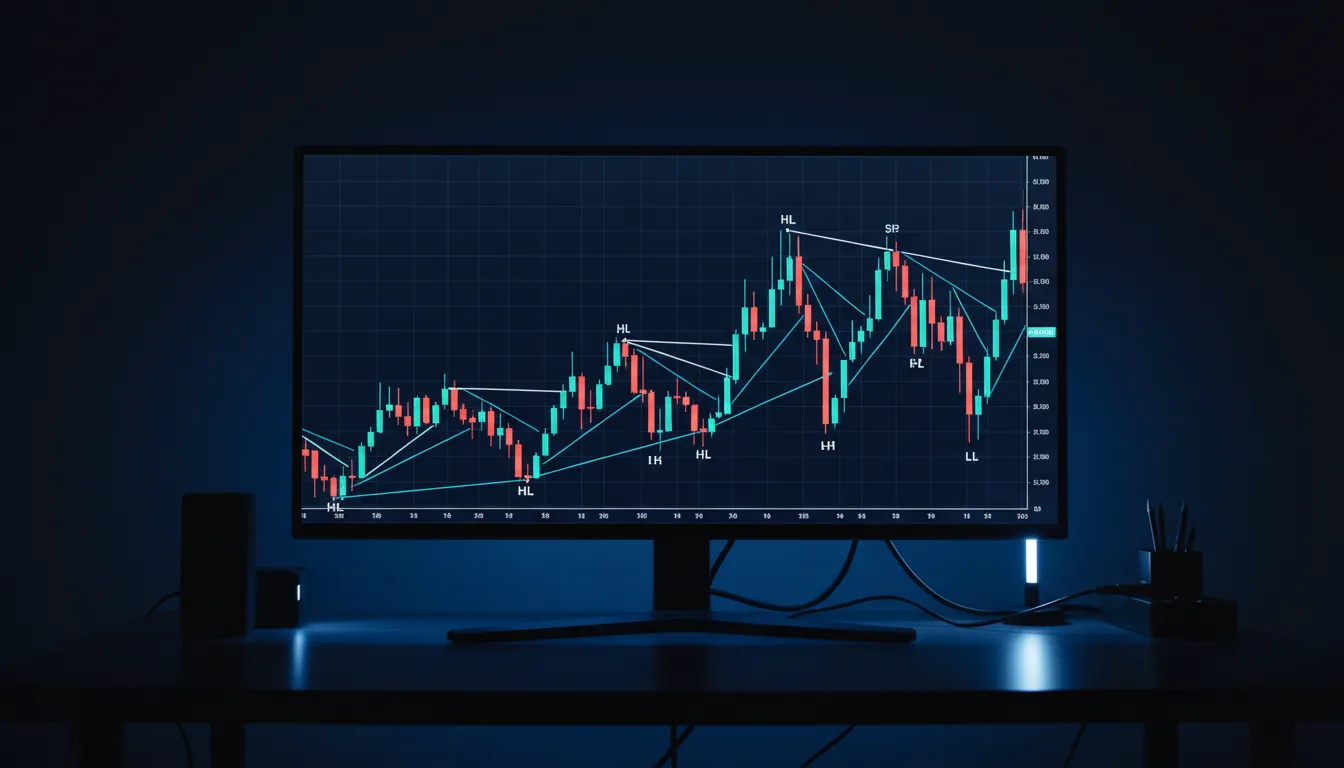
HH means higher high, HL higher low, LH lower high, LL lower low. They are the four labels you put on swing points to read market structure: HH with HL is an uptrend, LH with LL is a downtrend, and roughly equal swings are a range. The sequence, read in order, is the trend.
Key takeaway
Market structure is read through four swing points: higher highs (HH), higher lows (HL), lower highs (LH), and lower lows (LL). HH plus HL equals an uptrend; LH plus LL equals a downtrend; flat swings mean a range. When the sequence breaks, an uptrend's first lower low, say, the structure shifts and the trend may be reversing. This indicator-free framework is the foundation of price-action trading.
HH HL LH LL meaning in trading
The four abbreviations are the vocabulary of structure. A higher high (HH) is a swing high above the previous swing high; a higher low (HL) is a swing low above the previous swing low. Together, HH and HL describe price stepping upward, the definition of an uptrend. A lower high (LH) is a swing high below the prior one, and a lower low (LL) is a swing low below the prior one; together they describe price stepping down, a downtrend.
Reading them in sequence tells the trend's story. A clean uptrend prints HH, HL, HH, HL, each new high exceeding the last and each pullback holding above the prior low. A downtrend prints LH, LL, LH, LL. A range prints roughly equal highs and lows with no clear progression. The chart below shows an uptrend's higher-high, higher-low staircase.
Memorizing the four terms is trivial; the skill is identifying the swing points cleanly enough to read the sequence reliably. A common beginner error is treating every small wiggle as a swing point, which produces a noisy, contradictory read; focusing on the meaningful turning points that stand out gives a cleaner structure that actually reflects the trend.
What is market structure?
Market structure is the skeleton of a chart: the sequence of swing highs and swing lows that, read in order, reveals the trend. Price never moves in a straight line; it advances and retraces, leaving behind peaks (swing highs) and troughs (swing lows). The relationship between consecutive peaks and troughs, rising, falling, or flat, defines whether the market is trending up, trending down, or ranging.
This is powerful because it requires no indicators, only the price itself. By identifying the swing points and reading their sequence, you get a clean, objective read on the trend that updates as new swings form. Market structure underlies most price-action and smart money concepts trading, and it is the framework within which a break of structure or change of character is defined. Learning to read it is one of the highest-leverage skills in technical analysis, and it complements support and resistance directly.
Use the same five-step sequence on every chart:
| Step | Question | Output |
|---|---|---|
| 1 | Which timeframe governs the decision? | One fixed context timeframe |
| 2 | Where are the obvious swing highs and lows? | Only meaningful turning points |
| 3 | Are both highs and lows rising, falling, or flat? | Uptrend, downtrend, or range |
| 4 | Was the last break with or against that sequence? | Continuation BOS or possible CHoCH |
| 5 | Which swing would invalidate the read? | A specific structural level |
That final level turns a chart description into a falsifiable scenario. If you want a second pass on the labels, prepare the same screenshot through the AI chart analysis workflow, then compare the resulting structure with your own marks rather than accepting it automatically.
How do you read a trend from structure?
Reading a trend is a two-step process: mark the swing points, then check the sequence. Marking swing points means identifying the meaningful peaks and troughs, the turning points that matter, while ignoring minor noise. This is partly judgment, and it is where higher timeframes help, since they filter out the small wiggles that clutter lower ones and obscure the true structure. If your swing points come out differently every time you look at the same chart, comparing your marks against an AI read of a chart screenshot is a cheap way to see whether you are reading the sequence or reading your own position.
Once the swings are marked, the sequence answers the question. Rising highs and rising lows confirm an uptrend; you stay biased long while that holds. Falling highs and lows confirm a downtrend; you stay biased short. Roughly equal swings mean a range, where trend-following has no edge and the boundaries become the levels to watch. The discipline is to let the structure dictate your bias rather than imposing a view on the chart, an uptrend deserves long bias until its structure actually breaks, no matter how "overextended" it looks. This connects directly to multiple timeframe analysis, which aligns structure across scales.
What is a market structure shift?
A market structure shift is when the swing-point sequence changes character, signaling the trend may be turning. In an uptrend of higher highs and higher lows, the first failure, a lower low instead of a higher low, breaks the pattern and warns that buyers may have lost control. This first break against the trend is what smart money traders call a change of character (CHoCH), the earliest structural sign of a reversal.
The shift is significant because it is the structure itself, not an indicator, telling you the trend's defining pattern has broken. A confirmed shift, ideally with follow-through that builds opposite structure, flips your bias from one direction to the other. Until that shift occurs, a trend is presumed intact; once it does, the burden shifts to the new direction. Distinguishing a genuine shift from a temporary break (or a liquidity grab) is the key skill, covered in depth in market structure shift explained, change of character trading, and break of structure trading.
Not every break of a swing point is a real structure shift. A liquidity grab can briefly break a level and reverse back into the trend. Wait for a clean break, ideally a close beyond the swing point, before concluding the structure has shifted.
How do BOS, CHoCH, and MSS fit together?
The three structure signals answer one question each, and keeping them straight removes most of the confusion in structure trading. A break of structure (BOS) breaks a swing point in the direction of the trend and answers "is the trend continuing?" with yes. A change of character (CHoCH) is the first break against the trend and answers "could the trend be turning?" with maybe. A market structure shift (MSS) is a confirmed CHoCH, usually a decisive break with displacement through a swing that just swept liquidity, and answers "has the trend actually turned?" with a much stronger yes.
Read in that order, they form a simple decision ladder. A chain of BOS events keeps you with the trend. The first CHoCH puts you on alert but does not by itself flip your bias, since many CHoCHs turn out to be deep pullbacks. An MSS with follow-through, ideally after an inducement sweep and from a sensible premium or discount zone, is the point where structure genuinely favors the new direction. Traders working within the broader ICT framework apply exactly this ladder before looking for an entry.
What an AI chart reader can and cannot see in your structure
Marking swings is a well-defined visual task, so an image-based reader handles it reasonably: given a screenshot it can point at each peak and trough, label them HH, HL, LH or LL relative to their neighbours, state whether the sequence is rising or falling, and name the swing whose break would end the read. Because it applies the same rule to every chart, it is often more consistent than a trader who marks swings differently depending on the position they already hold.
Its blind spot is everything outside the image. It cannot see the swings that scrolled off the left edge, so a structure that looks like a fresh uptrend inside the frame may be a pullback inside a larger downtrend. It does not know the timeframe unless the screenshot shows it, and the same candles mean different things on a five-minute and a daily chart. It has no view on the session, the news calendar, or how many times that level has already been tested. So the honest split is this: let it do the labelling, and keep the higher-timeframe context and the decision for yourself. That is how the AI chart analysis workflow is designed to be used.
How do you trade with market structure?
Trading with structure means aligning your direction with the trend the structure shows and entering on pullbacks within it. In a confirmed uptrend (HH, HL), you look to buy retracements toward higher lows or structural levels, with a stop below the swing low whose break would damage the uptrend. The structure both sets your bias and defines your invalidation, where the trend would be proven wrong, which makes stop placement logical rather than arbitrary. Once that invalidation level is fixed, size the position before you enter so a break of the swing low costs a planned amount rather than whatever the market decides.
The same framework governs exits and reversals. You stay with the trend while its structure holds and step aside or flip when a confirmed structure shift says it has broken. This keeps you on the right side of the dominant move and out of fights against it, the most common way traders lose, shorting strong uptrends or buying steep downtrends because a move "looks extended." Anchored to firm risk control and read across aligned timeframes, market structure is a complete, indicator-free way to navigate trends. It is the backbone the rest of this price-action cluster builds on, from supply and demand zones to trendline trading. Plenty of software now claims to detect structure automatically, with very different results depending on whether it works from a live chart or an uploaded image, and this comparison of AI trading tools sets out where each one stops.
The deeper value of structure is that it gives objective rules for staying or leaving, replacing opinion with observation. Instead of agonizing over whether a trend "feels" tired, you simply check whether the swing-point sequence still holds: as long as the uptrend keeps making higher highs and higher lows, you stay long, regardless of how far it has run. The moment a confirmed lower low breaks that sequence, your bias changes, not because of a prediction, but because the structure itself changed. This removes a great deal of the emotional second-guessing that derails traders, which is why building decisions on structure rather than feeling is one of the most stabilizing habits in technical trading.
Educational only. Not financial advice. Market structure is a descriptive framework, not a guaranteed predictor, and structure can break unexpectedly. Examples use illustrative data. Always do your own research.
Frequently asked questions
- What is market structure?
- Market structure is the pattern of swing highs and swing lows that defines a trend. An uptrend makes higher highs and higher lows; a downtrend makes lower highs and lower lows; a range makes roughly equal highs and lows. Reading this sequence tells you the trend's direction and health.
- What do HH, HL, LH, and LL mean?
- HH is a higher high, HL a higher low, LH a lower high, and LL a lower low. HH and HL together define an uptrend; LH and LL together define a downtrend. They are the shorthand for the swing-point sequence that builds market structure.
- How do you read a trend from market structure?
- Identify the swing highs and lows, then check the sequence. Rising highs and rising lows mean an uptrend; falling highs and lows mean a downtrend. When the sequence breaks, for example a higher low fails, the trend may be shifting.
- What is a market structure shift?
- A market structure shift is when the swing-point sequence changes, such as an uptrend's first lower low, signaling a possible reversal. It is closely related to the change of character concept in smart money trading.
- What timeframe should I use for market structure?
- Higher timeframes give the cleanest structure and the most reliable trend read; lower timeframes show more noise. Many traders read structure on a higher timeframe for context and use a lower one to time entries.
- What is the HH HL LH LL pattern?
- It is the four-label shorthand for swing structure. HH is a higher high, HL a higher low, LH a lower high, LL a lower low. An HH and HL sequence is an uptrend, an LH and LL sequence is a downtrend, and mixed or flat swings are a range.
- What does HL mean in trading?
- HL means higher low: a swing low that sits above the previous swing low. It is the pullback half of an uptrend, the evidence that buyers stepped in before price reached the last low. Its mirror is LH, a lower high, which is the rally half of a downtrend.
- What does LL mean in trading?
- LL means lower low: a swing low below the previous swing low. Paired with LH, lower high, it defines a downtrend. An uptrend's first LL is the break in the sequence that warns the trend may be turning.
- How do you mark HH, HL, LH and LL on a chart?
- Mark every peak that is higher than the candles on both sides of it, and every trough that is lower than the candles on both sides. Then label each one relative to the previous peak or trough of the same type. Use the same number of bars either side so the labels stay consistent.
- What does a higher high and lower low at the same time mean?
- It usually means the chart is in an expanding range rather than a trend, with each swing overshooting the last in both directions. Trend-following reads have no edge there, and most traders wait for one side to stop expanding before taking a directional bias.
- Is HH HL LH LL the same as smart money concepts?
- No. HH, HL, LH and LL is plain swing structure and predates smart money vocabulary by decades. Smart money concepts build on top of it, adding terms like break of structure, change of character, order blocks and liquidity to describe what happens at those swing points.
About this byline
Markets & product research
The Bullynx editorial team researches and reviews the trading concepts, indicators, and tools we write about. Our articles are educational and are reviewed for accuracy before publishing. They are not financial advice.
Seeing this setup on your own chart? Upload the screenshot and Lynx AI maps the structure, the levels that matter, and a long or short bias, with what would invalidate it.
Keep reading
- Best Timeframe for Day Trading ChartsChart Reading & Patterns
- Best Timeframe for Swing TradingChart Reading & Patterns
- Break of Structure in Trading: How to Spot a Valid BOSChart Reading & Patterns
- Breakout Trading Strategy: Entry, Stop and TargetChart Reading & Patterns
- Support and Resistance in Crypto: Drawing LevelsChart Reading & Patterns
- Three Black Crows: Bearish Reversal SignalChart Reading & Patterns
Educational only. Not financial advice. NFA. Bullynx is not a registered investment adviser or broker-dealer. Trading and investing involve significant risk of loss. Read the full risk disclosure or how this article was researched and reviewed.