
Trendline Trading: Draw and Trade Them
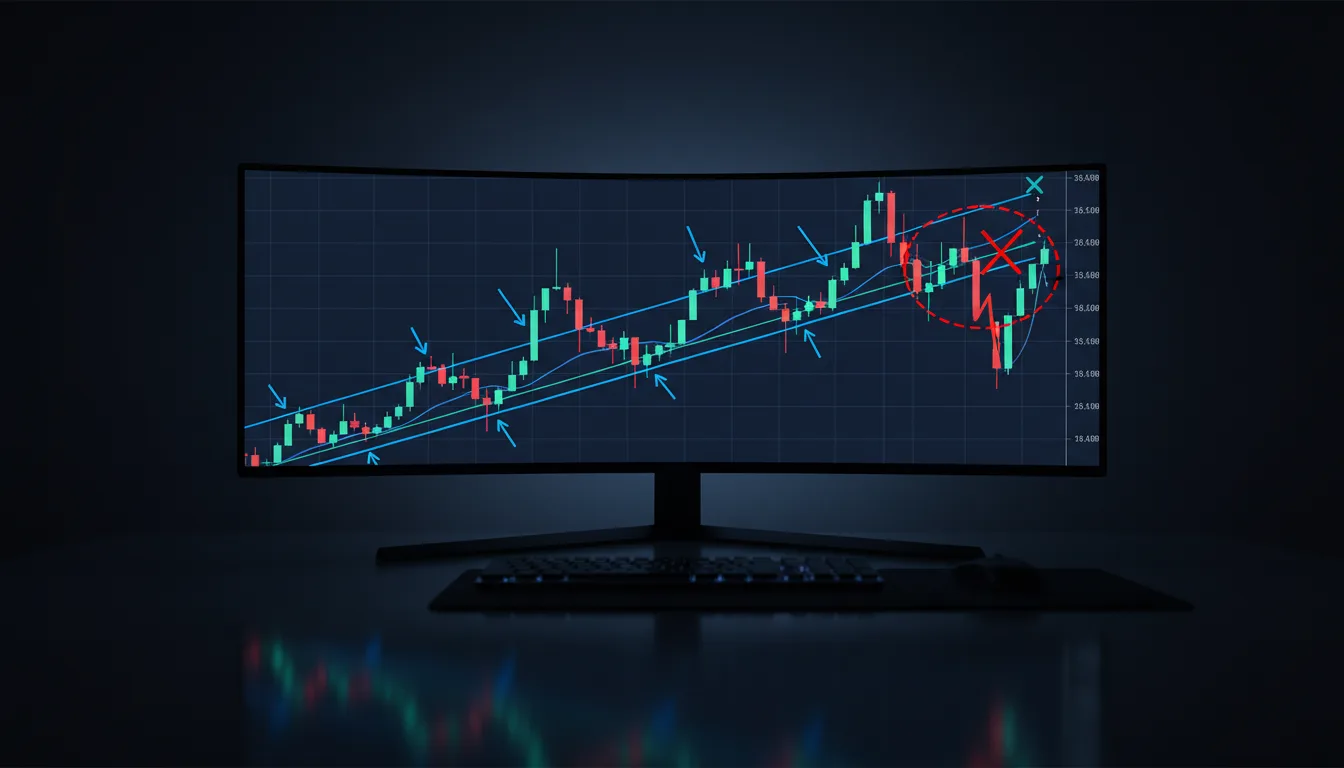
Trendline trading uses a straight line connecting swing points to define a trend and act as dynamic support or resistance. An uptrend line connects rising swing lows; a downtrend line connects falling swing highs. Traders use trendlines to trade bounces in the trend's direction and to spot breaks that may signal a reversal, turning the abstract idea of a trend into a concrete level they can act on.
Key takeaway
A trendline connects swing lows (uptrend) or swing highs (downtrend), acting as dynamic support or resistance. Draw it with at least two touches, confirmed by a third. Trade bounces off the line in the trend's direction with a stop beyond it, and treat a clean break and close through the line as a possible reversal, confirmed by a retest. Trendlines are somewhat subjective, so consistency in how you draw them matters.
How do you draw a trendline?
Drawing a trendline starts with the trend's swing points. For an uptrend, you connect the rising swing lows, the troughs that mark each pullback's bottom, with a straight line that slopes upward. For a downtrend, you connect the falling swing highs. The line then projects forward as a dynamic level: in an uptrend it acts as support, where price has bounced before; in a downtrend, as resistance.
You need two points to draw a line, but a third touch is what confirms it as meaningful, showing that price genuinely respects the level rather than the line being a coincidence. A choice you must make consistently is whether to connect wicks (extremes) or candle bodies (closes); both are valid, but mixing them produces sloppy lines. The goal is a line that touches the swing points cleanly without cutting through price. This is the angled cousin of horizontal support and resistance, and it relies on correctly reading the swing points of market structure.
How do you trade a trendline bounce?
The most common trendline trade is the bounce, entering in the trend's direction when price pulls back to the line and reacts. In an uptrend, you watch for price to retrace down to the rising trendline (dynamic support) and show a sign of buyers returning, a rejection wick or reversal candle, then enter long. The stop sits just below the trendline, the point at which a bounce has clearly failed. The mirror applies to downtrend lines for shorts.
The appeal of the bounce is that it lets you join a trend at a favorable price with a tight, logical stop, the line itself defines where you are wrong. The chart below shows price bouncing off a rising trendline within an uptrend.
A bounce is most reliable when the trendline aligns with the higher-timeframe trend and ideally coincides with another level, adding confluence. A trendline that has held several clean touches is also more meaningful than a freshly drawn one, since each respected touch is evidence that participants are genuinely acting at that level rather than the line being a chance fit.
How do you trade a trendline break?
A trendline break is the other side of the trade: when price decisively breaks through the line, it can signal the trend is weakening or reversing. A clean break of an uptrend line, where price closes below it rather than just wicking through, suggests buyers are no longer defending the level and the trend may be ending. Traders may then trade in the new direction or simply exit trend-following longs.
The danger is the false break. Price often pokes through a trendline only to reverse back, especially since trendlines are obvious places for stops to cluster, making them targets for liquidity grabs. To improve reliability, traders look for a candle close beyond the line and, ideally, a retest, where price returns to the broken line from the other side and is rejected, confirming the old support has become resistance (or vice versa). A break confirmed by a retest is far more trustworthy than a single spike through the line, a principle shared with break of structure trading.
Trendlines are obvious, so they attract stop orders and false breaks. A brief poke through a trendline is not a confirmed break. Wait for a close beyond the line and ideally a retest before treating the break as real.
What are the common trendline pitfalls?
The most common pitfall is forcing a trendline that does not fit, drawing a line you want to see rather than one the swing points justify. Traders often steepen or flatten a line, or connect non-comparable points, to make a chart confirm a bias. The fix is discipline: connect genuine swing points consistently, require the line to touch cleanly, and accept that not every chart has a clean trendline.
A second pitfall is treating trendlines as exact, when they are approximate like all such levels; price can react a little above or below the line, so allowing a small zone of reaction beats demanding a precise touch. A third is over-reliance, using trendlines alone without confluence from structure, levels, or candles. Because trendlines carry real subjectivity, two traders can draw different valid lines, they work best as one input within a broader read rather than a standalone signal. Used with that humility and confirmation, they are a clean way to visualize and trade a trend, complementing the price action trading toolkit.
Putting trendlines in context
Trendlines are among the oldest and simplest tools in technical analysis, and their value lies in turning the abstract idea of a trend into a concrete, tradable level. A well-drawn trendline gives you dynamic support or resistance to trade bounces from and a clear line whose break flags a possible reversal, all without any indicator. For visualizing the slope and health of a trend at a glance, few tools are as quick.
Their limitation is the flip side of their simplicity: subjectivity. Because where you draw the line involves judgment, trendlines reward consistency and confirmation over precision. Draw them the same way every time, demand clean touches and confirmed breaks, seek confluence with other reads, and anchor every trade to a stop beyond the line. Treated as one disciplined component of a price-action approach, trendlines remain a durable and useful skill, sitting alongside confluence trading and the rest of this cluster.
A final practical tip is to respect the angle of a trendline as information in itself. A gently sloping line reflects a steady, sustainable trend that can persist for a long time, while a very steep line reflects a fast, often unsustainable move that tends to break sooner. When price accelerates into a steeper and steeper slope, requiring you to redraw the trendline ever more aggressively, that parabolic behavior is frequently a warning that the move is overheating rather than a reason for confidence. Reading the slope, not just the touches, adds a layer of context: shallow and steady is healthy, steep and accelerating is fragile, which helps you judge how much weight to give any given trendline.
Educational only. Not financial advice. Trendlines are subjective, descriptive tools, not guaranteed signals, and false breaks occur. Examples use illustrative data. Always do your own research.
Frequently asked questions
- How do you draw a trendline?
- Connect at least two swing lows for an uptrend line or two swing highs for a downtrend line, with a third touch confirming it. Draw along the swing points so the line acts as dynamic support (uptrend) or resistance (downtrend).
- How many touches make a valid trendline?
- Two points are needed to draw a line, but a third touch confirms it as meaningful. More touches generally make a trendline more significant, though too many can also mean it is about to break.
- How do you trade a trendline bounce?
- In an uptrend, traders look to buy when price pulls back to the rising trendline and shows a reaction, with a stop below the line. The trendline acts as dynamic support, so a bounce continues the trend.
- How do you trade a trendline break?
- A clean break and close through a trendline can signal the trend is weakening or reversing. Traders may trade the break in the new direction, but false breaks are common, so confirmation and a retest improve reliability.
- Are trendlines subjective?
- Yes, somewhat. Different traders may draw a trendline slightly differently depending on which swing points they connect and whether they use wicks or bodies. Consistency in how you draw them matters more than finding the one correct line.
About this byline
Markets & product research
The Bullynx editorial team researches and reviews the trading concepts, indicators, and tools we write about. Our articles are educational and are reviewed for accuracy before publishing. They are not financial advice.
Seeing this setup on your own chart? Upload the screenshot and Lynx AI maps the structure, the levels that matter, and a long or short bias, with what would invalidate it.
Keep reading
- Best Timeframe for Day Trading ChartsChart Reading & Patterns
- Best Timeframe for Swing TradingChart Reading & Patterns
- Break of Structure in Trading: How to Spot a Valid BOSChart Reading & Patterns
- Breakout Trading Strategy: Entry, Stop and TargetChart Reading & Patterns
- Candlestick Patterns Cheat Sheet: The Key PatternsChart Reading & Patterns
- Change of Character (CHoCH): How to Identify ItChart Reading & Patterns
Educational only. Not financial advice. NFA. Bullynx is not a registered investment adviser or broker-dealer. Trading and investing involve significant risk of loss. Read the full risk disclosure or how this article was researched and reviewed.